
Supporting Safe and Reliable Water Infrastructure
Before construction begins on major water infrastructure, it’s critical to understand what’s happening below the surface.
For the proposed 4.5ML reservoir in Cooma, a focused geotechnical investigation was completed to support foundation design and reduce construction risk. The project was delivered for Snowy Monaro Council and provides essential data to guide safe, efficient, and cost-effective design decisions.
Project Snapshot
-
Project: Proposed Reservoir – Cooma
-
Client: Snowy Monaro Council
-
Location: Nimby Place, Cooma, NSW
-
Reservoir Capacity: 4.5 megalitres
-
Duration: 2 days
-
Project Lead: Roseller Oblimar
The purpose of the investigation was to confirm ground conditions, identify potential risks, and refine the pile design required for the new reservoir.
What the Investigation Involved
The investigation followed a clear, staged approach to build an accurate picture of subsurface conditions.
Desktop Review
Existing geotechnical reports, geological maps, and aerial imagery were reviewed to understand known site conditions and guide fieldwork planning.
Site Walkover
A field inspection was completed to:
-
Assess surface conditions
-
Identify access constraints
-
Flag potential risks before drilling
Drilling and Sampling
-
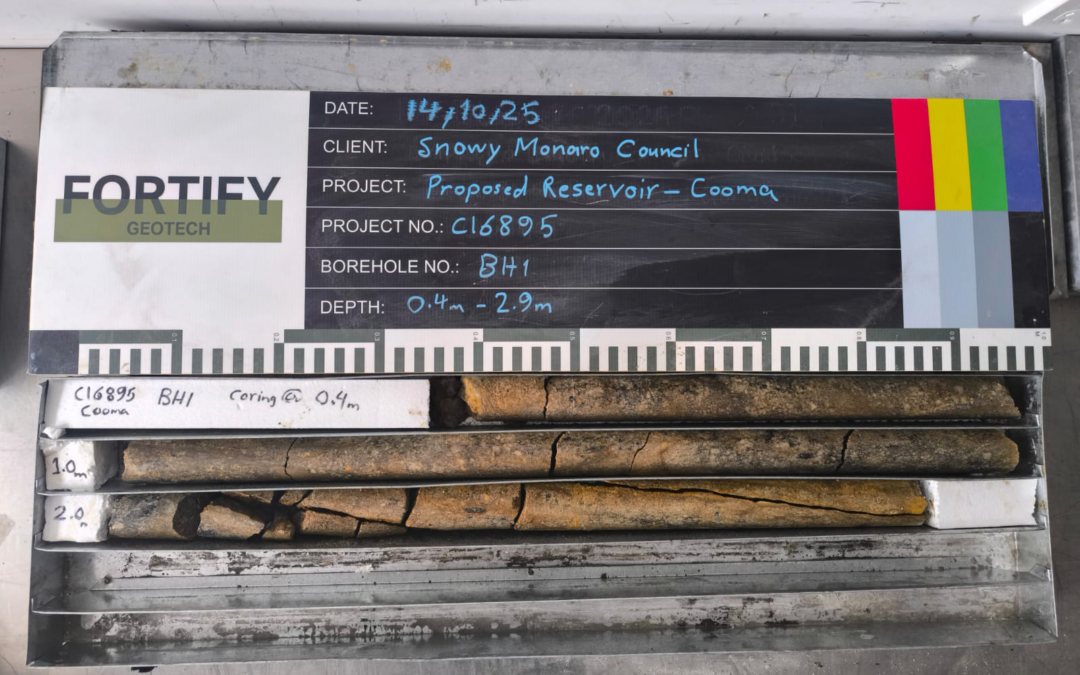
Two boreholes drilled and cored
-
Depths of up to 10 metres, or until competent rock was encountered
In-Situ Testing
-
Dynamic Cone Penetrometer (DCP) testing to assess shallow soil strength
-
Standard Penetration Tests (SPTs) to measure soil strength at depth
Laboratory Testing
-
Soil aggression testing at a NATA-accredited laboratory
-
Point load testing on rock core samples
Reporting and Reinstatement
All findings were compiled into a detailed geotechnical report, including foundation recommendations. Boreholes were backfilled and the site reinstated on completion.
Key Challenges on Site
Unknown Ground Conditions
The depth to bedrock, presence of gravel or boulders, and potential reactive soils were all unknowns that needed to be resolved to support pile design.
Site Access
Careful planning was required to allow a track-mounted drill rig and support equipment to safely access borehole locations across uneven terrain.
Underground Services
There was a risk of unknown underground services, creating potential safety and program impacts during drilling.
How These Challenges Were Managed
Early Planning and Service Checks
The project began with Dial Before You Dig (DBYD) searches, service locating, and a site walkover to reduce risk before drilling commenced.
Multiple Testing Methods
Using a combination of testing techniques provided a clearer understanding of ground conditions:
-
DCP testing for quick assessment of near-surface soils
-
SPT testing for deeper soil strength data
-
Rock coring to directly assess bedrock quality
On-Site Geotechnical Supervision
A geotechnical engineer was present throughout drilling to log materials, assess conditions in real time, and adjust the investigation as required.
Purpose-Selected Equipment
A track-mounted drill rig was used to manage varying ground conditions and improve site access and efficiency.
Project Outcomes
Better Design Confidence
The investigation provided reliable data to refine the pile design, supporting a safer and more efficient foundation solution.
Reduced Construction Risk
By identifying potential ground issues early, the project reduced the likelihood of delays, cost overruns, and unexpected conditions during construction.
Long-Term Community Benefit
The investigation supports the delivery of a safe and reliable 4.5ML water reservoir for the Cooma community — a critical piece of long-term water infrastructure.
Building Strong Foundations for Essential Infrastructure
Clear ground data leads to better decisions. This investigation gave Snowy Monaro Council the confidence to move forward with a key infrastructure project, backed by a solid understanding of site conditions and foundation requirements.